
UK non-domestic premises require a fire risk assessment under the Regulatory Reform (Fire Safety) Order 2005. However, a fire safety risk assessment for factories and warehouses is not the same as one for an office. Each facility’s assessment is different, so how can they be covered by the same 5 steps?
What is a Fire Risk Assessment?
The 5 steps of a fire risk assessment are set out in UK fire safety guidance and apply to any non-domestic premises:
- Identify fire hazards
- Identify people at risk
- Evaluate, remove, or reduce the risks
- Record findings, prepare an emergency plan, and provide training
- Review
Across facilities, the structure remains the same. What changes from site to site is how each step addresses a different hazard.
What Are the Specific Dangers of an Industrial Fire?
Industrial facilities carry greater fire risks than many other commercial environments, largely due to the machinery and chemicals involved in daily use. Heavy machinery generates heat and sparks, while many industrial processes involve flammable materials.
The potential dangers that arise from this are why industrial sites may also be subject to additional requirements alongside the FSO. The Dangerous Substances and Explosive Atmospheres Regulations 2002 (DSEAR) place specific duties on employers to control fire and explosion risks wherever flammable or explosive substances are handled on-site.
The specific dangers of industrial fires are:
- Damage to expensive machinery and equipment
- Significant operational downtime
- Financial losses
- Danger to staff and the wider public
- Compliance issues
Adapting the 5 steps of a fire risk assessment to the factory floor is what keeps a facility operating.
Fire Safety Risk Assessment: Factories and Warehouses
Identify hazards
On an industrial site, hazard identification starts with the machinery itself: heavy equipment in enclosed spaces, engines and large motors, electrical transformers, and any process involving flammable chemicals or fuel. Enclosed plant spaces, such as engine rooms or transformer housings, carry a different risk profile from the surrounding open floor areas and need to be assessed as distinct zones.
Identify people at risk
Factory floors rarely run on a single shift pattern. Contractors can move in and out, day and night, and identifying who’s at risk means accounting for who’s on-site at 3 am, not just those present during normal operating hours.
Evaluate, remove, or reduce the risk
This is where the right fire suppression system comes in. Once hazards and people are mapped, the question becomes, what system is appropriate for which zone? Machinery space, engine room, transformer housing, and storage area all come with their own considerations, which we’ll cover below.
Record, plan and train
Written records and emergency plans are only as effective as the people in charge of them. Fire warden training, delivered by accredited instructors and customised for each client, covers extinguisher operation, fire detection and alarm response, evacuation protocols, and hands-on system practice.
Signage matters, too. And on a large floor, with potentially compromised visibility, BS 5499-compliant escape route and exit signage can help people evacuate quickly.
Review
Factory floors can change more than other commercial facilities. New machinery, a new process line, or a change in what’s being stored or manufactured can shift your risk profile enough to warrant reassessment, regardless of when the last review took place.
Fire Suppression for Industrial Equipment
Fire suppression for industrial equipment is not a single specification. The right system depends on what’s being protected and where.
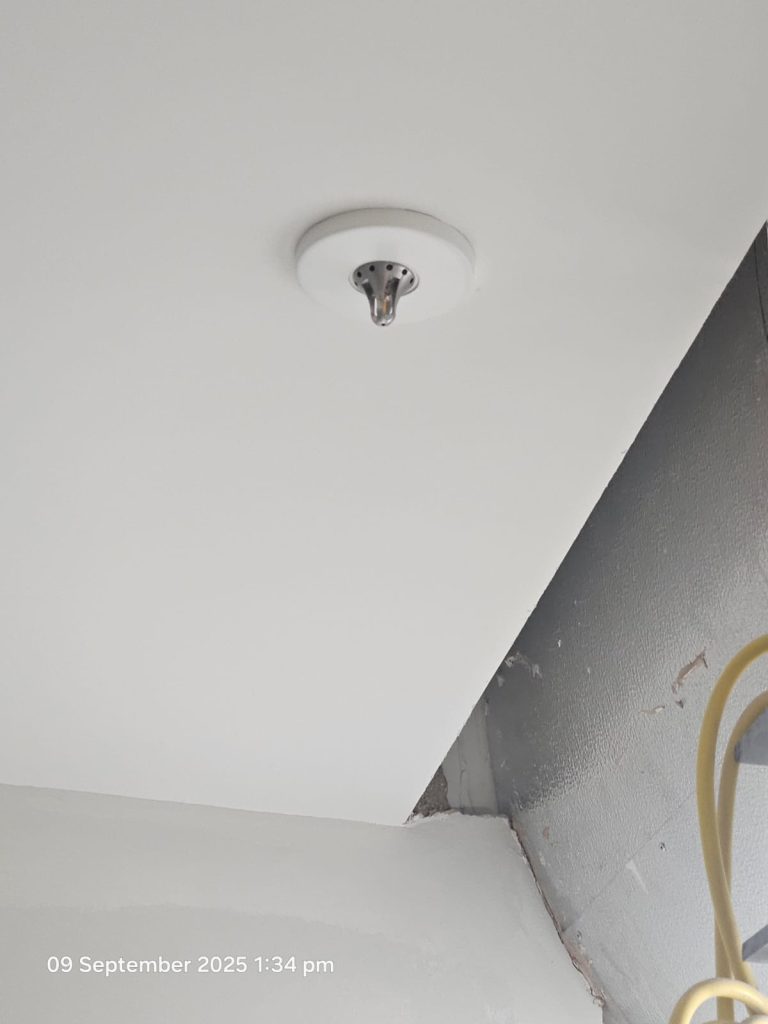
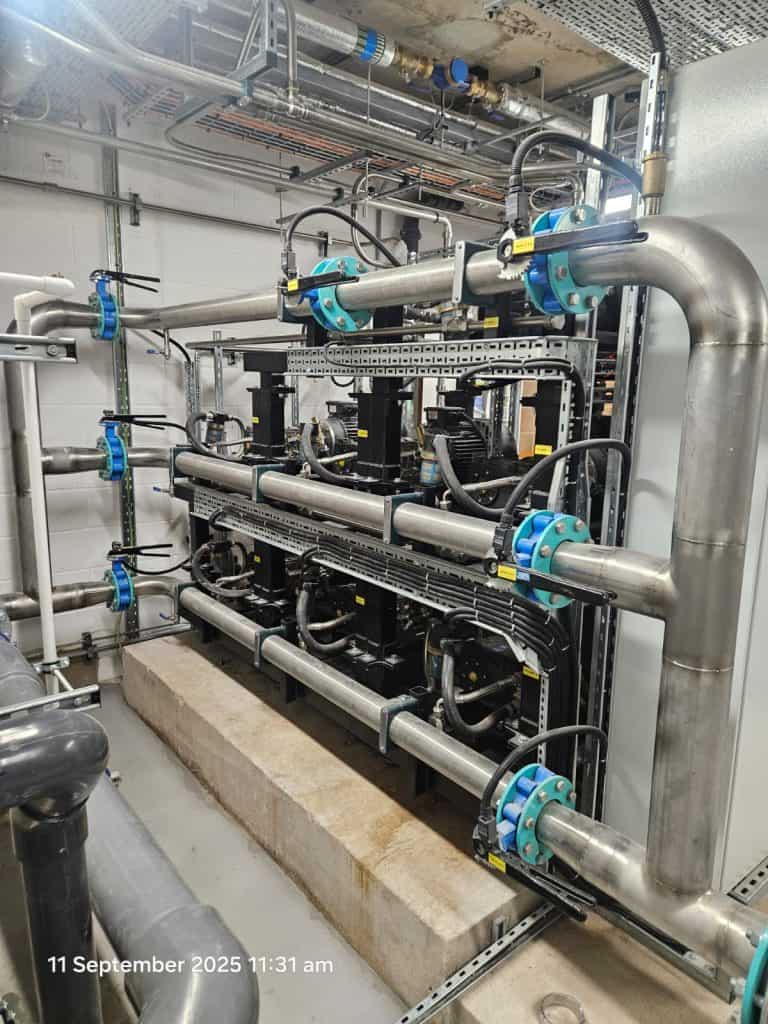
Watermist systems are generally the right fit for machinery spaces where sparks, heat, or fuel create a containment risk. High-pressure systems atomise water into fine droplets, delivering rapid cooling with minimal water volume. This matters where excess water could damage the equipment it’s meant to protect. Testing and performance requirements for these applications now sit under the BS EN 14972 water mist series, which has superseded the earlier BS 8489-5 industrial parts.
Gaseous suppression systems suit total flooding applications, such as control rooms, storage rooms, and other enclosed spaces where fast coverage is the priority. Clean agents extinguish without leaving residue or introducing water, which matters where sensitive equipment or electronics are present. Design, installation and maintenance requirements for these systems are covered by BS EN 15004-1:2024.
CAFS come into play where flammable liquid risk is present on the floor. The foam blanket cools, smothers and insulates in a way water alone doesn’t.
Matching Industrial Fire Suppression to Risk Profile
No two industrial facilities carry the same risk profile, which is why a factory floor’s suppression setup is rarely a single system. Combinations matched zone by zone are often the most appropriate approach.
For a fire risk assessment or a review of your factory floor’s current provision, get in touch with Combat Fire for a free site survey.