
In sensitive, high-risk areas, such as server rooms and laboratories, a fire suppression system has to minimise the risk of fire without causing further damage to equipment. When the risk of water damage rules out traditional sprinklers, facilities managers often turn to gaseous suppression as the alternative.
However, gaseous systems come with their choices, namely the choice between chemical agents and inert gas. Both extinguish fires reliably, but in different ways. Each agent also carries its own considerations for installation and long-term compliance exposure.
How Gaseous Suppression Works
Gaseous suppression works by ‘total flooding,’ covering the entire protected enclosure with an agent, rather than targeting the seat of the fire directly. Chemical and inert agents are non-conductive and leave no residue, which is why they are specified for rooms holding live electronics. In the UK, BS EN 15004-1 governs the design, installation and maintenance of these systems, with agent-specific parts covering the physical properties of each individual gas.
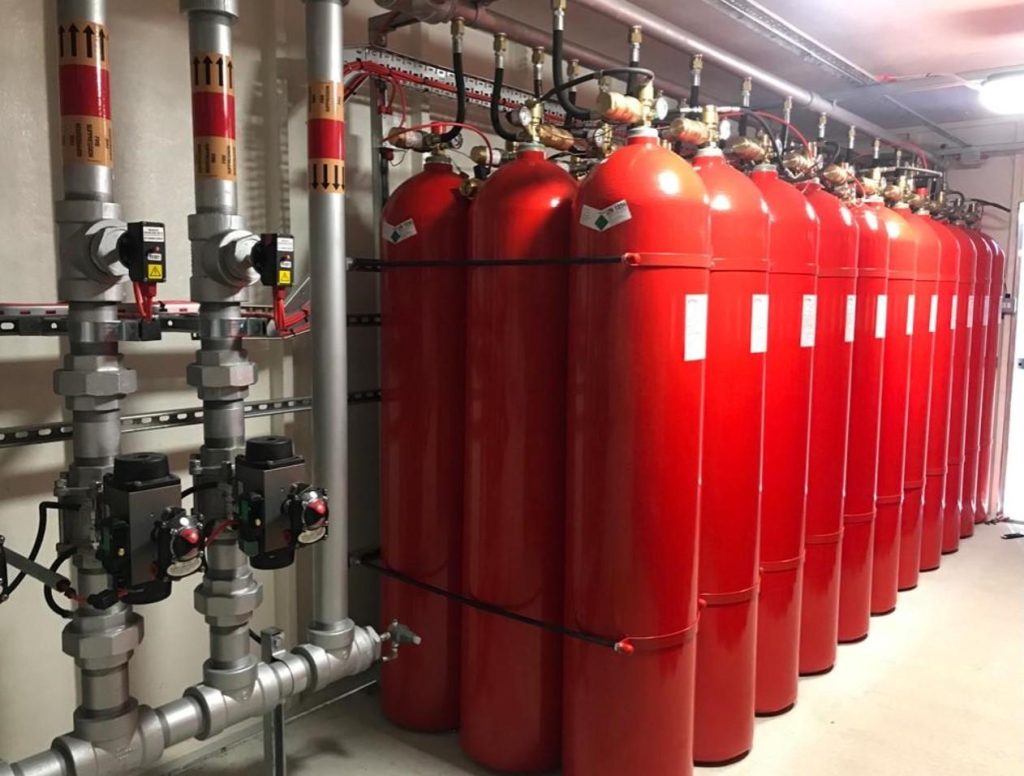
Composition of Inert Gas Fire Suppression Systems
Inert gas suppression uses gases already present in the atmosphere. Nitrogen (IG-100) is the most abundant, non-reactive and widely available. Argon (IG-01) is a noble gas, heavier than air, and useful where gas retention at lower levels matters. Nitrogen and argon can also be blended:
- IG-541 (Inergen): a mixture of 52% nitrogen, 40% argon and 8% carbon dioxide, the CO2 fraction stimulating breathing to aid evacuation.
- IG-55 (Argonite): a simpler 50/50 nitrogen-argon mix, common in server rooms and archives.
Chemical suppression relies on synthetic compounds instead:
- FM-200: otherwise known as HFC-227ea, this agent is a compound of carbon, fluorine and hydrogen, CF3CFHCF3.
- FK-5-1-12: previously marketed by 3M as Novec 1230, and now also produced as Fike SF-1230 and Kidde Fluoro-K, this agent is a synthetic fluorinated ketone, CF3CF2C(O)CF(CF3)2.
Inert Gas Fire Suppression: Oxygen Concentration and Extinguishing Mechanism
Inert gas and chemical agents extinguish fires in two distinct ways. Inert gas works by oxygen displacement, reducing the room from a normal 21% down to roughly 12-14%. This is low enough to stop combustion while still remaining breathable for the short amount of time needed to safely evacuate. Chemical agents work by heat absorption, interrupting the fire’s chain reaction at a molecular level rather than touching the room’s oxygen level. Both are safe at design concentration in occupied spaces.
Discharge Time for Inert Gas Fire Suppression Systems
FK-5-1-12 and FM-200 discharge in around ten seconds, while inert gas systems take 60-120 seconds to reach design concentration. This is a consequence of the larger volume of inert agent required, and can also be seen in their storage needs.
Chemical agents are held as a liquid at 25-45 bar. However, the cylinders, while compact, need to sit close to, or inside, the protected space. Inert gas is stored at 200-300 bar, allowing cylinders to be positioned up to 300 metres from the risk area. However, the overall cylinder bank is usually larger. On some single-cylinder applications, though, an inert cylinder’s actual footprint can be smaller than the chemical equivalent, so the “compact vs bulky” framing doesn’t hold in every case.
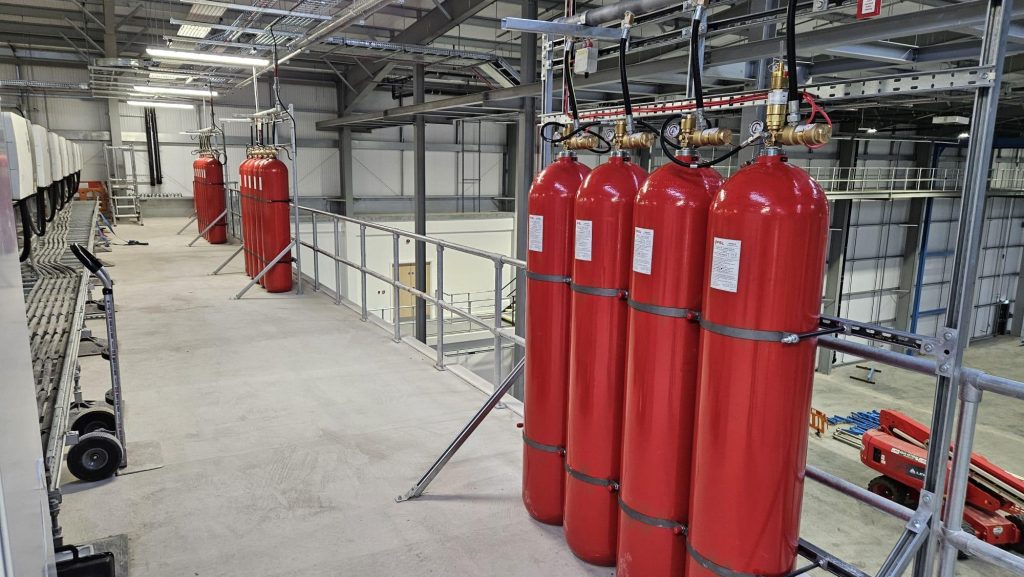
Fire Suppression Safety
FK-5-1-12 operates at a design concentration of around 5.6%, giving a wide margin below the level at which physiological effects appear. Inert systems manage the same question through NOAEL and LOAEL oxygen thresholds (38.5%-49.6%, respectively), with design concentrations calculated to hold occupants safely above the No-Observed-Adverse-Effect Level, even at higher-hazard settings.
Cost: Inert vs Chemical Fire Suppression
Inert gas is inexpensive to refill, with nitrogen and argon occurring naturally, with a much lower supply risk attached to the raw material. The trade-off is a larger cylinder bank and more floor or plant-room space.
Chemical agents need less hardware, but the agent itself carries a higher per-kilogram cost. Refilling proprietary synthetic chemical agents after discharge or accidental leaks is expensive, and the figures are rising as regulatory pressure on synthetic agents increases.
Atmospheric Lifetime of Inert Gases in Fire Suppression
Inert gases, such as nitrogen and argon, are already atmospheric constituents, not synthetic additions, so they carry no ozone depletion potential and negligible global warming potential. Chemical agents, however, are more complicated.
FM-200 has a GWP of 3,220 and is now working through a government-mandated phase-down under F-Gas regulation. FK-5-1-12 has a short atmospheric lifetime of around five days and zero ODP, but is classified as a PFAS compound (forever chemical).
3M stopped manufacturing its branded Novec 1230 at the end of 2025 as part of a wider PFAS withdrawal. The chemically identical FK-5-1-12 remains available from other manufacturers, so existing installations can still be recharged. However, the EU’s PFAS restriction proposal under REACH signals that this scrutiny isn’t easing.
Inerts vs Chemicals at a Glance
| Agent | Chemical Agent FK-5-1-12 | Chemical Agent FM-200 (HFC-227ea) | Inert Gas (IG-55 / IG-541 / IG-100 / IG-01) |
|---|---|---|---|
| Mechanism | Heat absorption | Heat absorption, chemical interruption | Oxygen displacement to ~12-14% |
| Safe in occupied rooms | Yes, at design concentration | Yes, at design concentration | Yes, within evacuation time |
| Global warming potential | Low, but compound is classified as a PFAS | 3,220 | Zero |
| Storage | Liquid, 25-45 bar | Liquid, 25-45 bar | Gas, 200-300 bar |
| Positioning | Close to/inside protected space | Close to/inside protected space | Up to 300m from the risk area |
| Discharge time | ~10 seconds | ~10 seconds | ~60-120 seconds |
| Refill cost trend | Rising, PFAS-linked pressure | Rising, F-Gas phase-down | Low |
Which System for Which Application
Chemical agents suit spaces where speed and a small footprint matter most, such as server rooms, telecoms cabinets and control rooms with limited plant space. Inert gas suits sites where storage space is available at a distance and long-term regulatory exposure is a planning concern, such as data halls, archives, and generator enclosures with a multi-decade service life ahead of them.
For system design, installation or a review of what’s already in place, take a look at Combat Fire’s gaseous fire suppression systems or get in touch for a free site survey.
FAQs
Are inert gas fire suppression systems non-conductive?
Yes. Nitrogen, argon, and blends such as IG-55 and IG-541 don’t conduct electricity, which is why they’re specified for rooms holding live switchgear and server racks.
Does inert gas fire suppression leave residue?
No. The agent disperses as a gas and leaves nothing behind on equipment, cabling, or surfaces. Post-discharge work is typically limited to ventilating the room and confirming the fire’s cause, not cleaning up the suppressant.
Do inert gas fire suppression systems cause corrosion?
No. Nitrogen and argon don’t react with metals, circuit boards, or insulation, so there’s no corrosion risk from the agent itself.
What is the GWP of inert gas fire suppression systems?
Effectively zero. Nitrogen and argon are naturally occurring atmospheric gases, so they carry no global warming potential and no ozone depletion potential.
What oxygen level do inert gas fire suppression systems reduce a room to?
Typically, from 21% down to around 12-14%, calculated to the specific design concentration required to extinguish the fuel present while remaining safe for short-term occupant exposure during evacuation.