
Water puts fires out and can damage everything it lands on. That’s the whole problem with protecting a server room, and it’s the reason data centre fire suppression should never start with a sprinkler system.
Why Server Rooms Get Treated Differently
The fires that start in comms rooms tend to be small. A sprinkler bulb won’t break until the air around it reaches roughly 68°C, by which point the fire has had all the time it needs, and the response is to spray water across live equipment.
Server room fire suppression using a gaseous agent works on a different principle. The system floods the whole room with an agent that interrupts the fire, then holds that concentration long enough for it not to reignite. Equipment that wasn’t burning continues to operate, meaning cleanup is often a ventilation job.
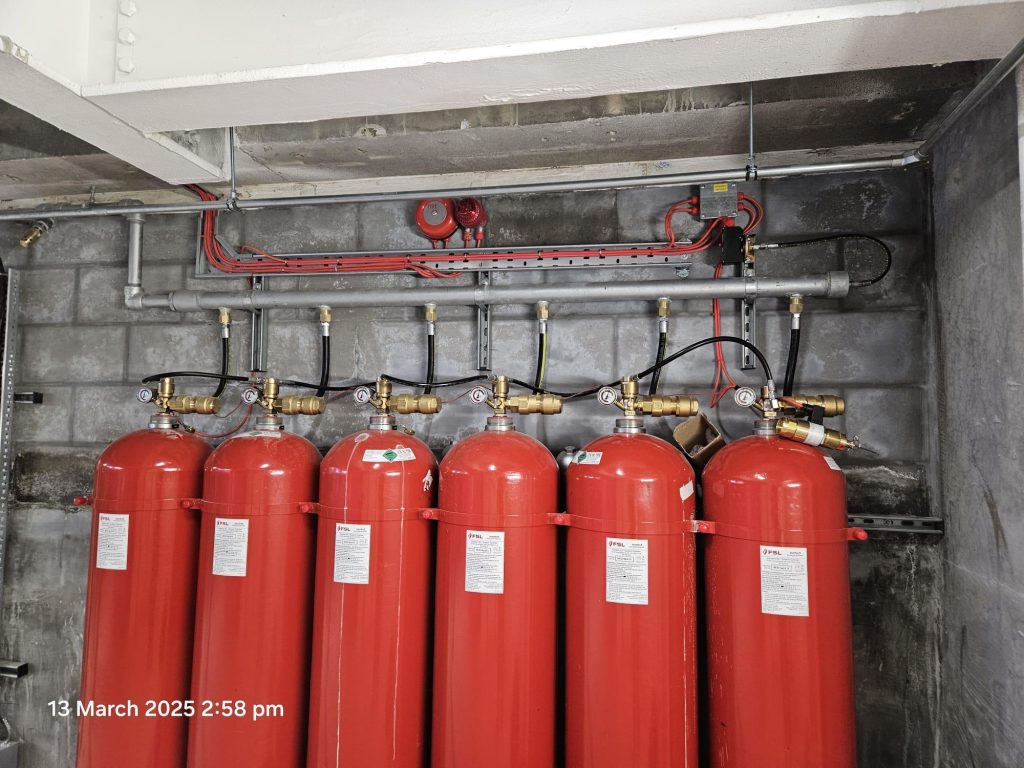
What Is a Clean Agent Fire Suppression System?
A clean agent is an extinguishing agent that doesn’t conduct electricity and evaporates without leaving residue.
Chemical agents such as FK-5-1-12 (the compound sold for years as 3M Novec 1230, and now as Fike SF 1230 and Kidde Fluoro-K) and HFC-227ea (FM-200) put out a fire mainly by absorbing heat very quickly, preventing combustion from sustaining itself. Oxygen levels barely move. That’s what makes them workable in rooms where people are sitting.
Inert gases go the other way. Argon, nitrogen, or blends like IG-55 and IG-541 are introduced into the room until oxygen drops from 21% to about 12%. Too low for flame; still breathable for the couple of minutes it takes to walk out.
CO2 gets used too, though not where anyone works. It suppresses by dropping oxygen well below survivable levels, so it belongs in plant rooms and unoccupied enclosures with proper lock-off arrangements.
Comparing the Main Agents
| FK-5-1-12 | HFC-227ea (FM-200) | Inert Gas (IG-55 / IG-541) | CO2 | |
|---|---|---|---|---|
| How it works | Heat absorption | Heat absorption, chemical | Oxygen reduction to ~12% | Oxygen reduction, severe |
| Safe in occupied rooms | Yes, at design concentration | Yes, at design concentration | Yes, with egress time | No |
| Global warming potential | Around 1 | Around 3,220 | Zero | Baseline of 1 |
| Storage footprint | Small, liquid in cylinders | Small, liquid in cylinders | Large, high-pressure cylinder banks | Moderate |
| Discharge time | About 10 seconds | About 10 seconds | 60 seconds or longer | Varies |
Data Centre Fire Safety Regulations in the UK
No regulation names gaseous suppression as compulsory. The Regulatory Reform (Fire Safety) Order 2005 places a duty on the responsible person to carry out a suitable fire risk assessment and put proportionate measures in place. For a room holding the systems a business runs on, that assessment tends to point to gas, and insurers frequently push in the same direction.
Once the decision is made, the standards that govern the work are:
- BS EN 15004 for the design and installation of gaseous extinguishing systems
- BS 5839-1 for the detection side
- Annual room integrity testing, the door fan test, which proves the enclosure still holds the agent for the required hold time
That last one constantly catches people out. Rooms change (or at least their contents do). Someone may pull a new cable tray through a wall, a recently hired contractor might lift a ceiling tile and not seal the opening behind it, and the agent now drains out of the room in 90 seconds rather than 10 minutes.
Worth knowing: 3M stopped manufacturing Novec 1230 at the end of 2025 as part of its withdrawal from PFAS production. Chemically identical FK-5-1-12 is available from other manufacturers, so existing systems can still be recharged.
Detection Is Your First Signal
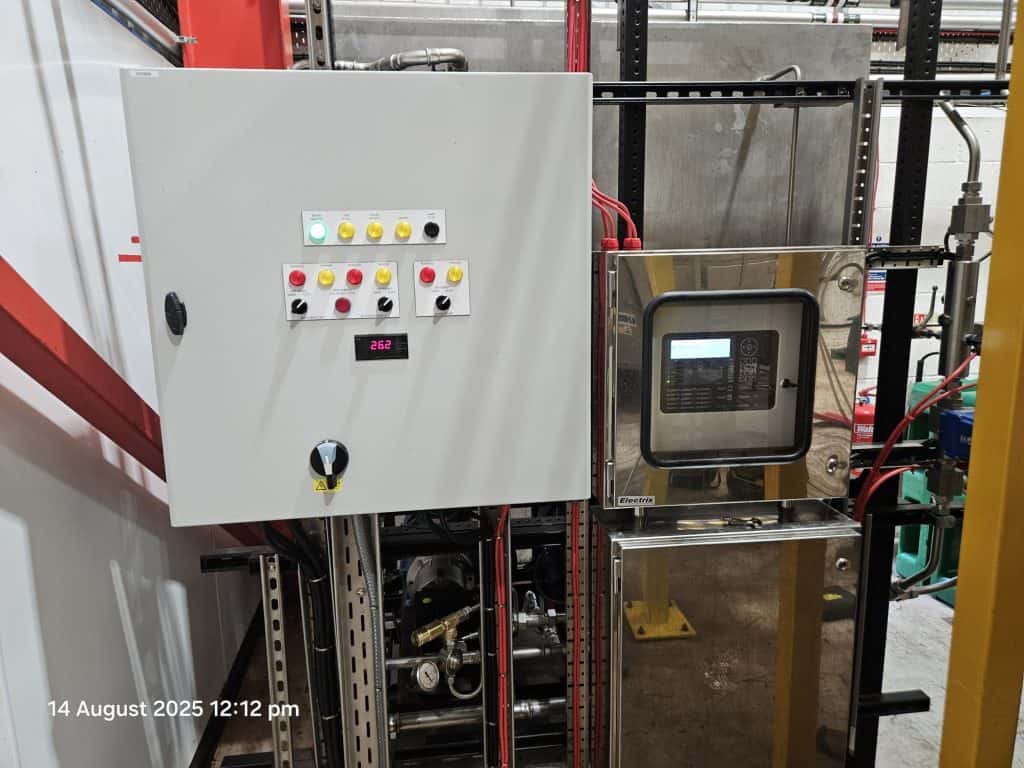
A suppression system is only as good as the thing that tells it to fire. Most well-designed installations use aspirating smoke detection, which draws air through a sampling pipe network and detects combustion products long before a point detector would notice. Combat Fire’s fire detection and alarm systems interface directly with suppression, so the release circuit isn’t an afterthought bolted onto a separate panel.
Servicing and Room Integrity
Agent weight checks, control equipment testing, device checks across the system and the annual room integrity test are all carried out in accordance with current British Standards. Details of the schedules are on the service and maintenance page.
If there’s one thing worth checking this week, it’s the seals around every penetration in the room: cable entries, ceiling voids, door bottoms.
For system design, installation or a review of what’s already in place, take a look at Combat Fire’s gaseous fire suppression systems or get in touch for a free site survey.