
There is no one universal fire suppression system. Different industries come with different risks, each suited to a different fire safety solution. Combat Fire designs, installs, maintains and services three main fire systems: gaseous, watermist and CAFS. Below, we’ve set out how each of these systems interacts with the hazards specific to the industries we protect.
Gaseous Fire Suppression System
Gaseous suppression works by ‘total flooding,’ covering the entire protected enclosure with an agent, rather than targeting the seat of the fire directly. Gaseous agents are generally divided into two categories: inert and chemical. Both inert and chemical systems are non-conductive and leave no residue. This is what makes them a particularly effective fire suppression system in areas with sensitive electronic equipment; the fire is controlled, while damage and downtime are minimal.
Inert gas systems use gases already present in the atmosphere to lower the concentration of oxygen to below the level required for combustion. Nitrogen (IG-100) is the most abundant gas in Earth’s atmosphere, and is non-reactive, while Argon (IG-01), a noble gas, is also non-toxic and present in the atmosphere. CO2 can also be used in gaseous systems, but only in unoccupied areas. Chemical agents rely on synthetic compounds, such as FM-200 and FK-5-1-12, which work by absorbing heat and disrupting the molecular chain reaction of combustion.
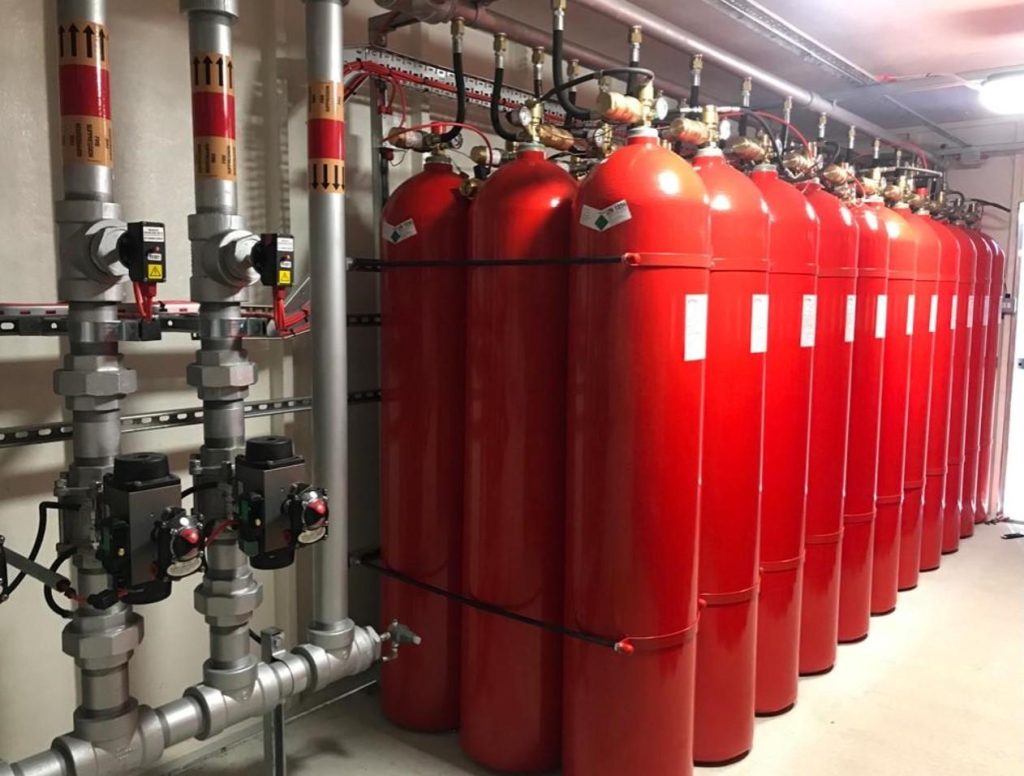
Gaseous systems work very quickly. And because they do not discharge water, gaseous systems avoid water damage associated with water-based suppression. There is also very little clean-up or downtime with a gas system. In the UK, BS EN 15004-1 governs the design, installation and maintenance of these systems, with agent-specific parts covering the physical properties of each individual gas.
Water Mist Fire Suppression
High-pressure watermist systems atomise water into much finer droplets than conventional sprinkler systems. The increased surface area helps the droplets absorb heat rapidly and evaporate, contributing to cooling and local oxygen displacement around the fire. Watermist systems are suited to data halls, generator rooms, switchboards and machinery spaces, any areas where minimising water damage, as well as fire damage, is a priority.
Watermist systems use less water than traditional sprinkler systems, often requiring smaller water tanks. With water as the extinguishing agent, watermist avoids the use of chemical or foam agents within the protected area. In terms of compliance, watermist systems are designed, installed, inspected and maintained according to the standard BS EN 14972.
Compressed Air Foam Systems
Compressed air foam systems (CAFS) inject air into a foam concentrate solution, creating an aerated foam that can coat fuel surfaces and help absorb heat. They work by discharging foam through fixed nozzles or monitors onto the fire, cooling, smothering and helping to limit flame spread.
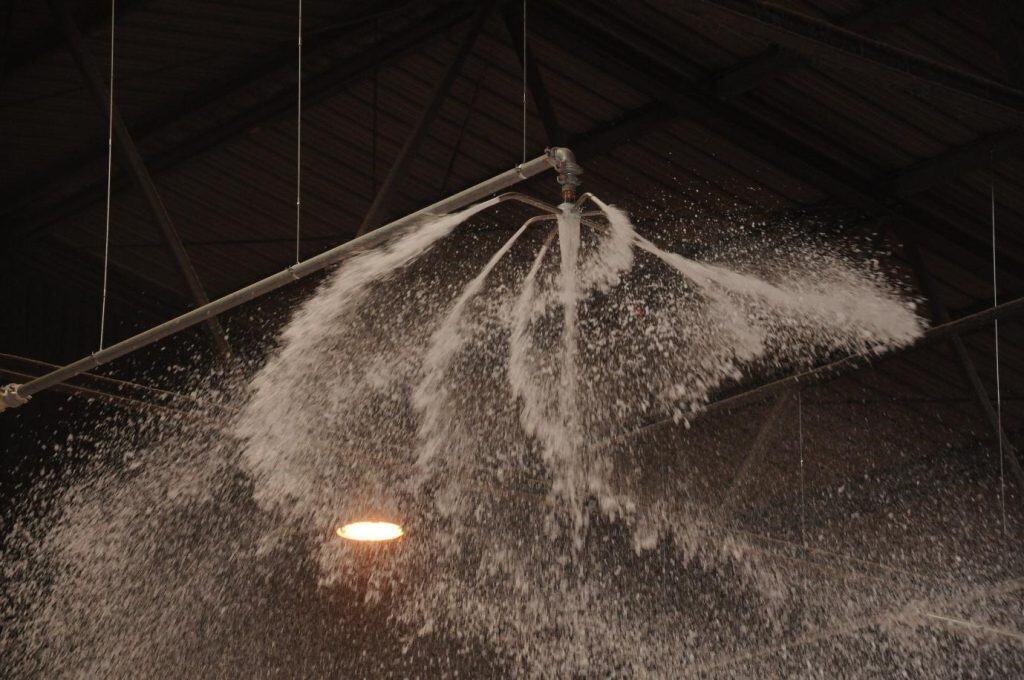
CAFS use different types of foam solutions depending on the manufacturer and the class of fire risk. Class A and Class B foam solutions differ in the types of hazards they protect against. Class A foam is designed for ordinary combustibles (wood, paper, textiles) and acts as a wetting agent, reducing water’s surface tension, allowing it to penetrate the fuel, cool it and prevent re-ignition. Class B foam is designed for flammable liquid fires (fuels, oils, solvents) and works by creating a film or blanket over the fuel’s surface to smother it and suppress vapour.
Like watermist systems, CAFS drastically reduce the amount of water needed to suppress a fire. They simultaneously cool fuel, smother flames and block oxygen, providing fast fire knockdown. CAFS are governed by BS EN 13565-1, which covers test methods for components, and BS EN 13565-2, which outlines proper construction and maintenance.
Automatic Fire Suppression by Industry
Education
Science laboratories in schools, colleges and universities store flammable solvents and use naked flames. DT workshops generate wood and plastic dust that can gather in ductwork and other dangerous areas. Server rooms store valuable student information while running day and night. The right suppression system has to stop fires at source and limit their spread to areas with students and staff, while minimising damage to expensive equipment.
Food production
Flour, sugar and starch create combustible dust that settles on surfaces and in extraction systems. Hot ovens run constantly while industrial fryers hold large volumes of cooking oil at temperatures close to their auto-ignition point. For food production facilities operating 24 hours a day, delays caused by fires are expensive. The right system is one that can handle the different fire risks while minimising downtime.
Hospital facilities
In healthcare facilities, a fire risk profile is shaped by its occupants. Many patients can’t be evacuated without significant help, while some patients can’t leave at all. Healthcare fire strategy relies on containing fire where it starts and protecting patients in place, while also remaining compliant with NHS-specific fire safety guidelines, such as the HTM 05 series.
Industrial plants
Common hazards across heavy and light industrial plants include combustible dust, flammable liquids, electrical failure in switchgear and control cabinets, overheating machinery, and hot work such as welding and grinding. Generator enclosures and CNC machinery, where hydraulic and cutting oils are present, often need local protection in their own right.
Laboratories
Laboratories combine flammable and reactive chemicals, naked flames and heat sources alongside expensive equipment, irreplaceable samples and research. There are also reactive chemicals that don’t pair well with water-based systems, and data storage requiring a residue-free agent. A single facility may need more than one type of system.
Matching the right risk to the right system
The right system for any given site depends on the specific hazard, room geometry, occupancy and insurer requirements. Fire suppression systems are not one-size-fits-all, which is why every Combat Fire system begins with a site survey.
| Industry | Watermist | Gaseous | CAFS |
|---|---|---|---|
| Education | Workshops, plant rooms and generator rooms | Server rooms, IT suites and archives | Flammable liquid stores |
| Food production | Ovens, process lines and generator rooms | Electrical switchrooms and control rooms | Deep fat fryers and oil storage |
| Healthcare facilities | Plant rooms and generator rooms | Server rooms, imaging equipment rooms and records archives | Fuel stores and waste handling areas |
| Industrial facilities | Machinery spaces, generator enclosures and paint lines | Switchrooms, control rooms and electrical cabinets | Flammable liquid storage, hydraulic oil hazards and high-pile storage |
| Laboratories | General lab areas and plant rooms | Instrument rooms, sample storage and data storage | Solvent stores and other Class B risks |
Again, system suitability depends on the specific fire risk, site conditions, system design and applicable standards. This table illustrates how an effective system differs across industries.
How Combat Fire Can Help
Combat Fire designs and specifies fire suppression systems according to the identified fire risk, application and relevant standard. From design and installation through to ongoing servicing, we can ensure that your fire safety remains effective and compliant with the relevant standards.
If you’re not sure which combination is right for your facility, Combat Fire can help assess your risks and find a solution that fits. Contact us today.