
The quick answer is that UK fire legislation does not specify a fixed review interval for fire risk assessments. The Regulatory Reform (Fire Safety) Order 2005 (FSO) requires that assessments remain “suitable and sufficient” at all times. In practice, many fire safety professionals recommend an annual review as a sensible baseline.
A yearly review isn’t written into the FSO itself, but within the industry, an annual review is a commonly adopted approach for many commercial sites, and may also form part of an insurer’s requirements for certain sites.
However, if you’re running a busier site, one review a year might not be sufficient. Higher-risk sites with multi-process manufacturing and complex, changing layouts generally require more frequent reviews to ensure your fire detection and suppression systems remain compliant and suitable for the current risk profile.
When is a Fire Risk Assessment Required?
When isn’t really a question of time; you need a fire risk assessment after certain events.
Your first assessment
Under the FSO, businesses must complete a fire risk assessment when they become responsible for a non-domestic premises. A new assessment or review will be required when:
- Your business now occupies new premises
- There’s been a change in personnel, such as a new facilities manager
- There’s been a material change to the building itself, such as an extension
Beyond the widely accepted annual review, there are a few more events that will trigger the need for a new review.
What triggers a review of an existing assessment
The classic example is a warehouse that starts storing flammable materials where it previously stored cardboard. Other triggers include:
- Building alterations or refurbishment
- Change of use, layout, or occupancy levels
- The introduction of new processes or materials
- A fire incident or near-miss
- Extended vacancy or significant staff changes
These events matter more than a calendar; they determine when you need to review your fire risk assessment. If one of the above incidents occurs a month after your annual review, waiting 11 months for your next review isn’t compliant. The 12-month review is a backstop for sites where nothing has changed.
What Does a Commercial Fire Risk Assessment Cover?
A fire risk assessment is a systematic review of the premises and the processes carried out within. It covers:
- Fire hazards and ignition sources
- The people who may be at risk
- Means of escape
- Fire detection and warning provision
- Whether existing control measures are still fit for purpose
Specific guidance on how an assessment should be structured can be found in PAS 79-1:2020. Published by the British Standards Institution (BSI), this framework sets out a recognised methodology for carrying out and recording fire risk assessments in non-domestic premises. A PAS 79-aligned report can identify what’s needed on-site to ensure compliance; whether that’s a change to a detection system, remedial building work, additional training, or nothing at all.
How Combat Fire Can Help
Combat Fire is a BAFE-certified company. This means we are certified against defined criteria for assessor competency and management processes to carry out fire risk assessments across a range of industries.
Our fire safety recommendations reflect your premises’ specific risk profile. Whenever an assessment identifies remedial action, we can deliver it under one team: detection, suppression, signage, and training. Our recommendations are based solely on the identified risk profile and required control measures. Each assessment begins with a site review and a written quotation before any work is undertaken.

What you’ll get
- A written, documented fire risk assessment
- Named findings and recommendations specific to the site
- A record of who carried out the assessment
- A review interval recommendation based on the site’s actual risk profile, not a generic annual stamp
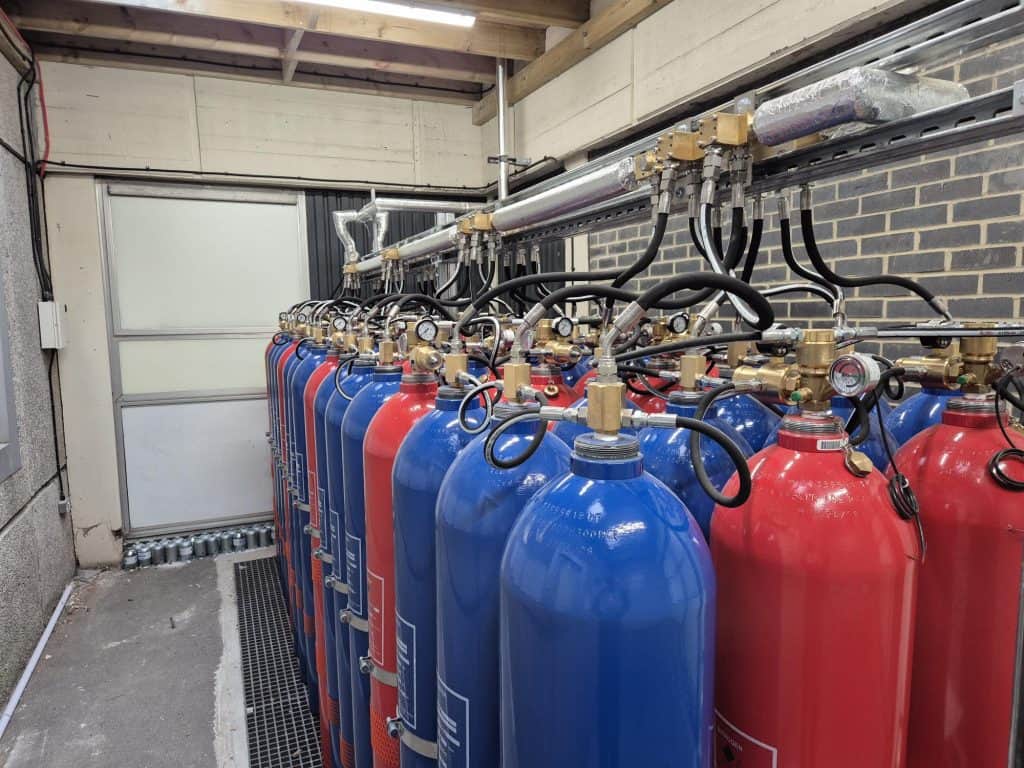
Where an assessment points toward a suppression requirement, Combat Fire designs and installs systems matched to the hazard identified:
- Watermist: high-pressure systems (up to 120 bar) deliver rapid cooling and oxygen displacement using minimal water volume. Suited to machinery spaces, generator rooms and industrial process areas.
- Gaseous: inert gas or chemical clean agents extinguish fire without residue or damage to electronics. Used in server rooms, switchrooms and telecoms facilities.
- CAFS: compressed air foam cools, smothers and insulates via an aerated foam blanket. Suited to appropriate food production and process-line applications.
For a fire risk assessment or a review of an existing one, get in touch with Combat Fire for a free site survey.